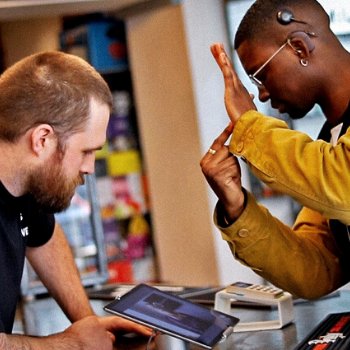
Businesses often overlook Deaf awareness.
However, it’s essential that you’re prepared to cater to Deaf customers as well as those who can hear.
This practical guide is designed to help you and your staff recognise your Deaf and hard of hearing customers, so you can interact politely and thoughtfully without fear of offending.
Through provisions and strategies such as BSL interpreters, BSL courses and Deaf awareness training, as well as smaller day-to-day adjustments, you can make your business fully accessible to all.
Recognising the signs
No one can be expected to preface every interaction with a new person by disclosing that they are Deaf or hard of hearing. So, it may be up to you to pick up on some subtle clues. Here are a few things to look out for that could indicate that the person you are speaking to has hearing loss:
- The customer watches your lips closely (possibly trying to lipread)
- Frequent requests for repetition or clarification, especially if you’re in a quiet environment
- Confused or unexpected responses
- A delay before answering a question
- Visible hearing aids or other assistive technology
Respectful communication strategies
If you think someone may be Deaf or have hearing loss, your next step is to make communication easier without drawing unnecessary attention or making them feel singled out.
Here are a few strategies you might try using.
Face the customer directly to make sure your mouth is visible when speaking, to allow lipreading.
Speak clearly and naturally. There’s no need to exaggerate your mouth movements or shout, which may come across as patronising.
Keep background noise to a minimum if possible. Use visual aids, such as pointing to items or writing down key information (especially prices, times or instructions).
Finally, always check for understanding. A simple ‘Would it help if I write that down?’ can go a long way.
Dos and don’ts
When you meet a customer you suspect may be Deaf or hard of hearing, you should:
- Make eye contact and use positive body language, including smiling.
- Schedule any meetings to take place in quiet, well-lit spaces with as few people present as possible.
- Be patient, giving the customer plenty of time to process and respond without unnecessary pressure.
- Use short, clear sentences.
- Make use of alternative communication options.
However, make sure you don’t:
- Shout- it’s not only rude but can actually distort your speech, making it even harder to be understood.
- Put pressure on the customer, or get annoyed by their delayed responses.
- Use lots of jargon or acronyms that require further interpretation.
- Equally, there’s no need to address them like a child.
- Speak only to their interpreter, if they have one. It’s essential to continue to address the customer directly.
Not everyone will want assistance. But if it’s clear that the customer is struggling, you may like to offer it to them. You could simply and politely ask if there’s anything that you can do to make things easier for them.
Common misconceptions about hearing loss
It can be easy to fall into the trap of making assumptions about hearing loss. Doing so can sometimes mean that you overlook certain signs that might help to guide your interaction with your customer.
For example, many people assume that hearing loss is something that affects only older people. In fact, it’s estimated that 1.1 billion teenagers and young adults are at risk of hearing loss. It’s important to remember that this is something which could affect people of all ages, including your customers.
Another common misconception is that hearing aids work to correct your hearing in the same way that glasses correct sight. In fact, hearing aids rarely correct hearing to 100% effectiveness, and often require a level of training to use successfully. So, don’t assume that just because someone wears a hearing aid, they will have full hearing ability.
Tips for creating accessible service environments
The steps you need to take to ensure that your business is accessible to Deaf customers will depend on many factors, particularly the industry and type of environment you operate in.
However, here are a few things you might consider doing to support your Deaf customers.
Keep background music low or off, especially in customer-facing areas, and consider installing a hearing loop in your business.
Provide your customers with accessible communication methods, such as email addresses or chat boxes, so they aren’t forced to rely on phone calls to make contact with your business.
Provide clear visual signage and avoid relying on verbal instructions only. If you’re using video, captions could be added to aid comprehension.
Consider whether you could offer BSL interpreters, or use BSL courses to help your staff learn basic BSL phrases to greet or assist customers. Staff Deaf Awareness Training can also help build understanding and grow confidence among your team.
How can Sign Solutions help?
Sign Solutions provides comprehensive support for businesses looking to improve accessibility for Deaf customers. Our services include professional BSL interpreting, both face-to-face and remote. Our InterpretersLive! platform offers on-demand BSL interpreting through video, providing flexibility for unplanned interactions.
We deliver Deaf Awareness Training to build your team’s confidence in welcoming Deaf customers. We also offer consultancy services, helping you assess your business’s current accessibility and develop a practical improvement plan. Our team can advise on physical modifications, communication support options and marketing strategies specifically for the Deaf community.
To find out more about making your business more accessible to Deaf customers, call Sign Solutions on 0121 447 9620, email bookings@signsolutions.uk.com or contact us via a BSL video interpreter.