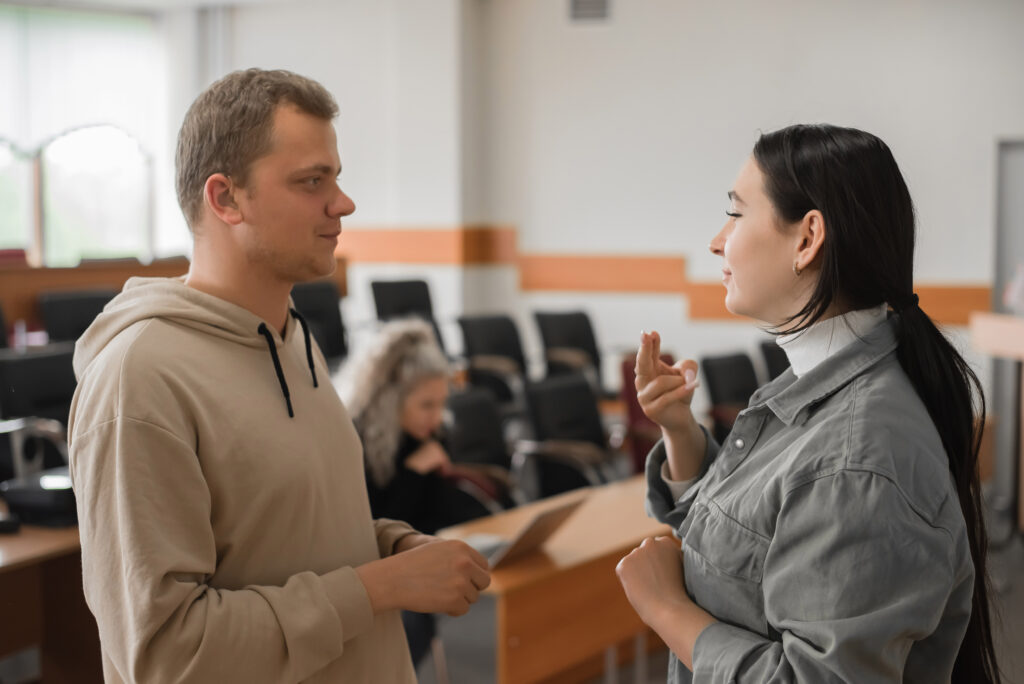
Speech-to-text reporters play an important part in the communication process for Deaf people. They provide much needed translations of events happening around them. Without a speech-to-text reporter, deaf people would be at a disadvantage when trying to communicate with hearing people.
A speech-to-text reporter (STTR) is someone who takes audio of speeches and turns them into text. This is usually done in real time, so the text can be used by people who are Deaf or hard of hearing.
STTRs use a specialised form of shorthand that allows them to type very quickly, so they can keep up with the speaker. They also need to be able to understand different accents and speaking styles. Being an STTR is a demanding job, but it’s also extremely rewarding, providing vital access for deaf people who might otherwise miss out on important information or events.
Here, we take a closer look at what STTRs do and the role they play.
What is a speech-to-text reporter?
STTRs are professionals who have the ability to transcribe any word that is spoken.
They are an invaluable resource for Deaf people. These communities often struggle to communicate with others, but STTRs can offer a solution. They use stenotype or palantype – which are specially-adapted shorthand keyboards – to type every word that is spoken, phonetically, which is then shown in written English on a large screen or computer for the Deaf audience to understand.
Who uses a Speech-to-Text Reporter?
Speech-to-Text reporters have been used by many organisations like schools, Government agencies, and hospitals to provide communication support for the deaf and deafblind communities.
The Equality Act 2010 highlights certain situations where there is a responsibility on employers to make ‘reasonable adjustment’ for any Deaf or Hard of Hearing employees and hiring an STTR could be one of these adjustments for a better working environment.
The NRCPD have details of registered STTRs in your area, so you have peace of mind that you’re hiring a trained professional to work with your Deaf staff or students.

What are the different types of communication professionals?
There are several different communication professionals working within the Deaf and Hard of Hearing communities. Hearing loss can vary in severity from person to person, so what works for one person may not work as well for the next. As well as STTRs, Deaf people may also use the following for communication support:
BSL interpreters
These are responsible for translating British Sign Language into spoken English, and vice versa. They need to be able to fluently understand and sign BSL, as well as have a good grasp of English grammar and vocabulary. No matter where they are working, their primary goal is to ensure that communication between Deaf and hearing people is clear and effective.
BSL translators
BSL translators play a significant role in ensuring that Deaf or hard of hearing people can communicate effectively with the wider world. They translate what’s being said to provide communication access for Deaf people. They need to be able to sign fluently in BSL. In some cases, they may need to use other forms of communication, such as fingerspelling or tactile signing, if the person they are communicating with has difficulty understanding BSL.
Lipspeakers
A lipspeaker is a professional who helps Deaf or hard of hearing people communicate through lipreading. They use a range of techniques, including facial expression and body language, to help their clients understand what they are saying. Lipspeakers work with people of all ages, from young children to adults. They often work in schools, hospitals and other customer-facing settings.
How Sign Solutions can help
Sign Solutions provides on demand and around the clock interpreting, training and translation services nationwide, enabling Deaf people to communicate more effectively and gain equal access to information, products, services, education and work.
We work closely with a large number of qualified Interpreters and communication support workers across the UK, who all have extensive experience supporting Deaf, Deafblind and Hard of Hearing people. They can facilitate your communication needs in any domain, from legal or business to medical, educational, conference, community and even theatre.
To find out more, and for expert advice on which type of communication support will meet your needs, give us a call on 0843 178 0773, email bookings@signsolutions.uk.com or contact us via a BSL video interpreter.