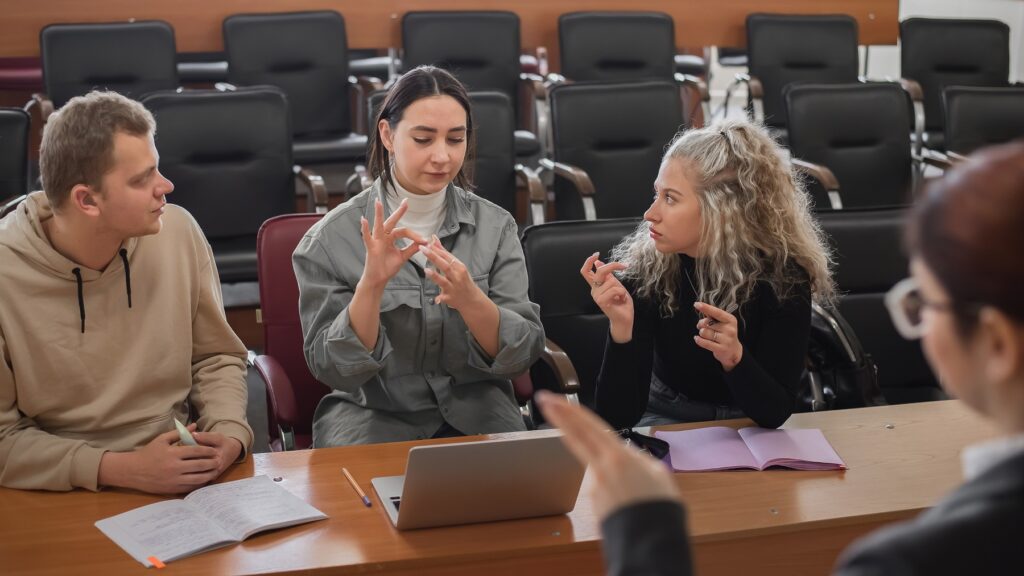
With a new school year beginning in just a few weeks, it’s crucial that schools, colleges and universities alike provide an inclusive education for Deaf students.
For too long, there’s been a lack of support and accessibility for Deaf students, and this needs to change.
With many teachers unable to cater to students with disabilities, and a lack of specialised staff available, mainstream education settings continue to unwittingly exclude Deaf students.
When teaching programmes and educational settings are inclusive, it allows Deaf individuals to access the same opportunities as everyone else.
Inclusivity and accessibility in education mean Deaf people develop their skills and knowledge, giving them the same life chances as their hearing peers.
Inclusive education is an approach that aims to provide a supportive and accessible learning environment for students of all abilities.
It goes beyond mere integration by embracing diversity and ensuring that each student receives the necessary support and accommodations to participate fully in the educational experience.
Inclusive education is not only a matter of providing physical access to classrooms but also about creating an inclusive culture where every student feels valued and supported. By embracing inclusion, we foster a society that recognises the inherent worth and potential of every individual, regardless of their differences.
It’s important to understand that being Deaf is not solely a matter of hearing impairment. It’s also a unique linguistic and cultural identity. Many members of the Deaf community communicate primarily through sign language and share a rich cultural heritage.
Deaf individuals often face challenges in accessing education due to communication barriers and the lack of understanding about their needs.
Traditional educational approaches heavily rely on auditory cues and spoken language, which can create significant barriers for Deaf students.
However, with inclusive education, we can bridge these gaps and provide Deaf students with equal access to education, communication and social opportunities.
This blog aims to shed light on the crucial role of inclusive education in empowering Deaf individuals. Its goal is to raise awareness and inspire action among educators, policymakers and communities to create inclusive educational environments that embrace and celebrate the diversity of the Deaf community.
So, whether you’re an educator, a student, a parent or someone passionate about fostering inclusivity, this article will provide you with insights and strategies to support the educational journey of Deaf individuals.
British Sign Language GCSE and what it means for the Deaf community
Last year, British Sign Language (BSL) was officially recognised as a language in the UK. And now, the Department for Education is aiming for a BSL GCSE to be taught to pupils from September 2025.
In June 2023, the Government launched a consultation that will see employers, teachers and members of the Deaf community being asked for their views on what should be taught as part of this qualification.
This new GCSE will help make education more inclusive and give hearing students a better opportunity to learn sign language and about Deaf culture.
Education Secretary Gillian Keegan said: “It is fantastic that British Sign Language will soon be taught in schools up and down the country.
“This new qualification will break down barriers, advance equality of opportunity, and celebrate the history and rich culture of British Sign Language.”

How educational settings can be more inclusive for Deaf students
Access to education is a fundamental right for everyone, including Deaf people. Inclusive education ensures that Deaf children and students with hearing impairments have equal opportunities to learn and grow.
It’s about providing the necessary accommodations to support their unique learning needs. When barriers are removed, Deaf individuals can unleash their full potential and contribute to society in meaningful ways.
Here are some of the main things to consider:
Optimise communication methods
When it comes to communication, Deaf students use various methods such as speech, lipreading and signing. Lipreading and sign language are the most common methods used by students with hearing loss. Therefore, it’s essential to have proper communication adjustments for instances where a Deaf student needs to contact their tutors or teachers. This could be having a video relay service such as InterpretersLive! an on-demand video interpreting service enabling a BSL user the option to call the school through a remote sign language interpreter, accessed by the school or university website.
Create an inclusive environment
A learning environment where every student feels comfortable and included is crucial. For Deaf and hard of hearing students, this could mean having access to a sign language interpreter or additional resources to aid in understanding.
Become ‘Deaf Aware’
Education professionals can benefit greatly from receiving Deaf awareness training, which teaches them about the Deaf community, the challenges they face and the best ways to communicate with them. This training can be provided in person or online through e-learning, and it can help education workers feel more confident when interacting with their Deaf students. In addition to learning about Deaf culture, our training programme also includes a lesson in basic British Sign Language (BSL). This can help educators feel more comfortable when greeting their Deaf students, asking about their wellbeing and more.
Listen to your Deaf students
Understanding the lived experiences of your Deaf students and faculty members is the surest way to improve inclusion in your educational setting. Regular evaluations of your school’s or university’s accessibility will allow you to identify areas for improvement. By incorporating student feedback, you’ll be able to create a more inclusive learning space for all students.
How Sign Solutions can help
If you’re an organisation looking to become more inclusive and accessible for your employees and customers, we can help.
With a range of training programmes and courses, including British Sign Language training and Deaf Awareness courses, we can work with you to make your business better.
For further details and advice, please phone 0121 447 9620, email bookings@signsolutions.uk.com, or contact us via a BSL video interpreter using InterpretersLive! via the website or app.