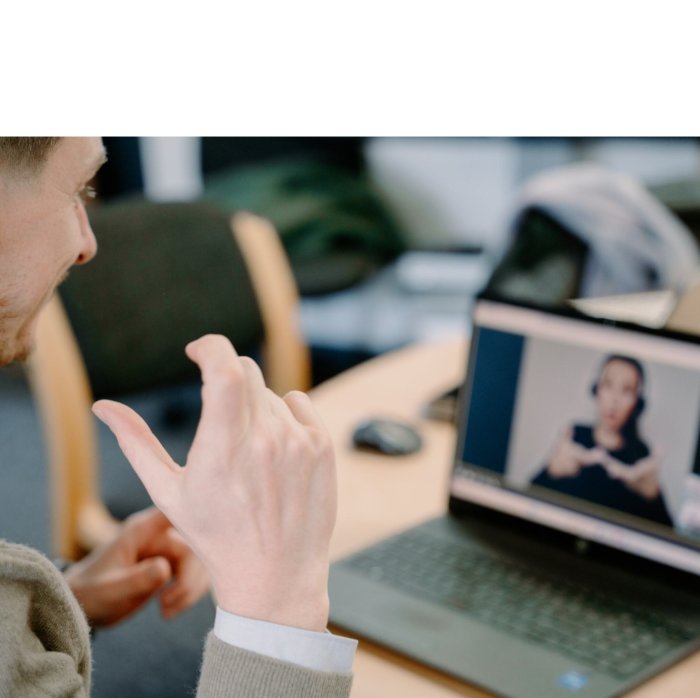
British Sign Language (BSL) interpreters ensure that a Deaf person has the same access to information and ability to be a part of the conversation as any hearing person in the room.
When you select a BSL interpreter to support your organisation, you want to be confident they’re fully qualified and able to offer comprehensive and accurate interpretation that allows everyone to stay in the loop.
The National Registers of Communication Professionals working with Deaf and Deafblind People, or NRCPD, helps organisations in the UK to ensure that they’re hiring trustworthy, highly competent BSL interpreters.
What is the NRCPD?
The NRCPD is the voluntary regulating body that maintains registers for communication professionals, including BSL interpreters, lipspeakers, speech-to-text reporters and more. They work to ensure that the professionals you choose to hire are highly qualified individuals, working to a professional code of conduct.
NRCPD-registered interpreters will have met strict criteria in terms of qualifications in their field and committed to evidencing regular CPD to keep their knowledge and skills up to date.
They’re also subject to a formal complaints procedure, so in the unlikely event that you experience any issues with your interpreter, this can be managed externally.
Why registration matters
Hiring a BSL interpreter can be a significant investment for any organisation. You should rightly expect that the interpreter is working to the same high standards as any other employee.
Quality assurance in this area can be difficult if you yourself are not fluent in BSL.
NRCPD-registered BSL interpreters are trained to handle complex, nuanced and sensitive information and avoid misunderstandings. This can be particularly important if you operate in a field where there can be no ambiguity.
The NRCPD’s code of conduct ensures interpreters behave professionally, including ensuring confidentiality where it’s necessary. In short, NRCPD registration is a safeguard that ensures a high quality of service for Deaf clients and organisations.
NRCPD registration categories
When you search the NRCPD register, you’ll see that there’s more than one category:
- Registered Sign Language Interpreters (RSLI) – Fully qualified individuals who are recognised as meeting all professional standards. They’re fluent in two or more languages and will interpret between a signed language and spoken English.
Registered Relay-Intralingual Sign Language Interpreters – Some Deaf individuals will use a variant of BSL, perhaps simplified or incorporating regional variation. They may struggle to follow standard BSL. These professionals are able to adapt to this more personalised, non-standard form of BSL. - Registered Interpreters for Deafblind People – For people who are both Deaf and blind, these highly specialised interpreters can aid communication. They relay speech as well as visual information.
- Registered Sign Language Translators – These professionals translate written materials into BSL.
- Registered Lipspeakers – Many Deaf people rely on lipreading. Lipspeakers are trained to be easy to lipread.
- Registered Notetakers – These individuals provide clear written summaries or real-time notes on the interactions taking place for the client to read.
- Speech-to-Text Reporters – Similar to notetakers, these provide a real time written record of interactions for the Deaf person to follow. However, these will typically be word-for-word transcripts as opposed to summaries.
Qualification requirements and assessment
To become an NRCPD-registered BSL interpreter, a professional must:
- Complete an approved course, usually a Level 6 BSL qualification.
- Complete a full DBS check.
- Agree to a rigorous code of conduct, including clauses on ethical principles and confidentiality.
- Complete at least 24 hours of CPD annually. This may include attendance at courses and workshops, or ‘unstructured’ exercises which contribute to a set of objectives.
This process is designed to ensure interpreters have the technical skill and cultural awareness to work in a wide variety of settings. While there are plenty of skilled interpreters who are not registered, booking someone without NRCPD accreditation carries risks.
There’s no formal accountability if something goes wrong and no guarantee of training, ethics or CPD. Confidentiality and impartiality can’t be assured or enforced. In sensitive contexts, these risks can have serious consequences.
Practical advice for organisations
The NRCPD website provides a really easy way to search for an interpreter and verify their accreditation.
If you’re unsure of which category of interpreter you need, your best bet is a fully registered RSLI.
You can also hire trainees, which might suit your needs well in certain situations. However, where stakes are higher, such as in medical or legal situations, it’s important to use a fully registered professional.
You could consider providing Deaf Awareness Training for your team to improve communication and inclusivity, even when no interpreter is available. This allows your team to operate day to day without the constant need for the services of interpreters.
If you’re unsure, or feel you would benefit from some additional advice, Sign Solutions can match you with the right interpreter for your needs. So, if you want to make your organisation more inclusive, accessible and confident in communicating with Deaf people, contact us today for advice, interpreter bookings or Deaf Awareness Training.