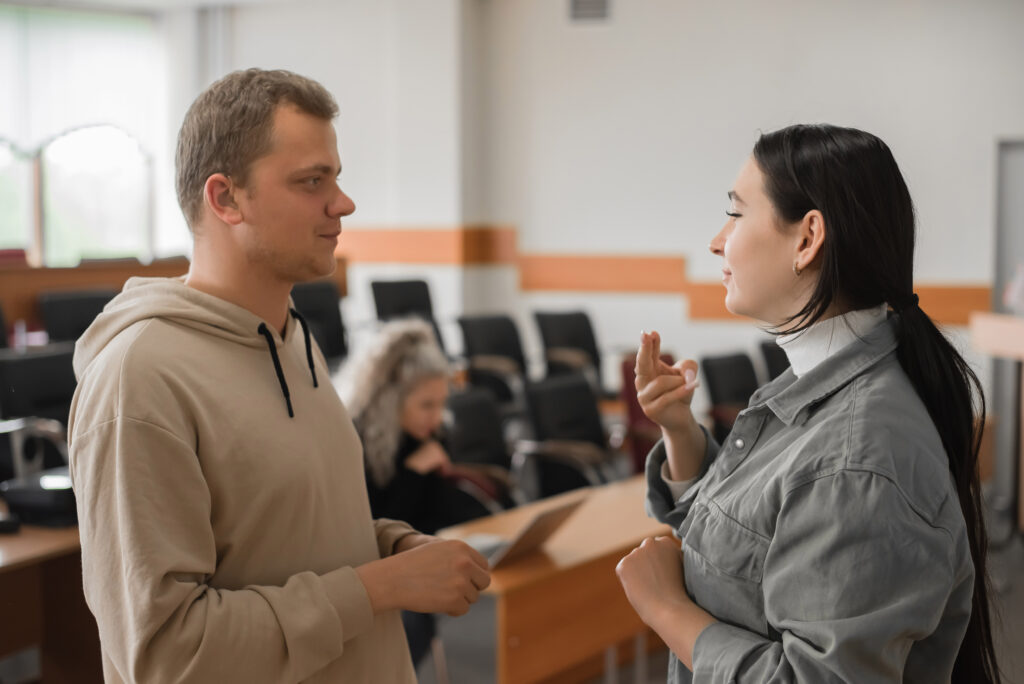
Many businesses underestimate what happens when Deaf and hearing professionals collaborate in the workplace.
The assumption is that communication barriers will slow everything down. This hesitation makes sense. How do you run meetings? What about phone calls? Will projects take longer? These are practical concerns any manager would have. However, the reality can be quite the opposite.
Companies that hire Deaf talent report unexpected benefits. Teams develop better habits, meetings become more productive and visual communication improves across the business.
Bringing Deaf and hearing people together might feel challenging at first. You might be worried about how they will communicate and reach goals as one team?
However, the changes you make for your Deaf or hard of hearing employees – initially for accessibility and inclusion – end up benefiting everyone.
Your staff likely already possess the necessary skills and mindset to make things work. So, the gap between where you are now and creating an environment where your Deaf and hearing colleagues work well together is probably smaller than you think.
Making communication work for everyone
Communication shapes every moment in the workplace. When a team includes Deaf or hard of hearing members, you must adjust your communication methods to fit everyone’s needs.
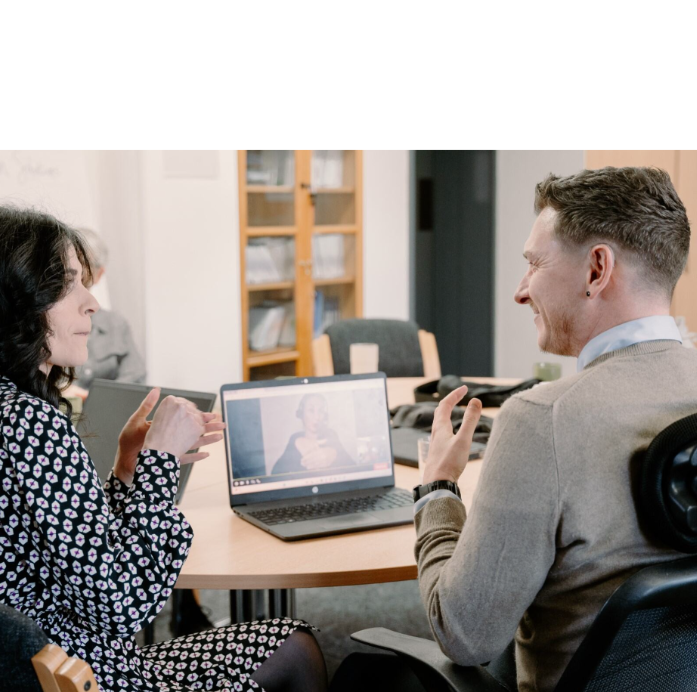
At times, professional interpreters play a vital role. Their presence at meetings, training sessions and casual catch-ups ensures that your Deaf employees receive information clearly and participate fully, both in understanding what others are saying and feeling able to contribute to the conversations themselves. You might find that video relay interpreting or remote interpreting services better meet your organisation’s needs.
There are all sorts of other things you could install, many of them very simple. Hearing loops in meeting rooms, real-time captioning apps, shared digital notes, visual alerts, clear signage, effective use of whiteboards – even positioning speaking people in appropriate lighting where it’s easier to read their lips. Teams might alter meeting formats, such as sharing agendas beforehand or allowing extra time for questions. Visual cues, such as written summaries or slide decks, improve clarity and prevent misunderstandings. It’s all very straightforward, and most of these benefit others as well as Deaf individuals. Hearing colleagues often sharpen their communication skills and develop greater empathy.
And Deaf people help communication improve in their own way, too. For instance, ensure you develop a culture that encourages your Deaf or hard of hearing employees to confirm if they understand or need clarification. Encourage their input in whatever form they’re most comfortable with, whether that’s speech or writing. Ask them to be honest about what’s truly best for them.
And remember, clear communication isn’t a one-way street. Your hearing colleagues should take the time to learn simple sign language basics or practice face-to-face speaking with good lighting and minimal background noise. Ultimately, the goal is a communication culture where Deaf and hearing staff feel equally heard and understood and develop a mutual rapport and respect.
Adapting the workplace to fit all employees
Every workplace scenario brings challenges and opportunities to ensure Deaf and hearing people can work well together.
For example, you could adjust your typical brainstorming sessions to shift from rapid-fire speech to a more structured format. Encourage turn-taking and written input so that your Deaf employee can both understand and contribute.
If you’re running a training programme, why not include live interpretation or recorded material with subtitles?
Even informal chats between employees in the tea room or over lunch can benefit from adjustments. They could meet in quieter spaces or use instant messaging apps that support video clips with sign language.
For example, we collaborated with Barnet Council to establish a video interpreting service that supports Deaf employees managing mixed teams. They use interpreters and communication technology to lead meetings and projects smoothly.
These adjustments aren’t burdens. They create a fantastic working environment that treats all employees equally and fosters teamwork, problem-solving and collaboration. As your teams become accustomed to these changes, those old barriers begin to fade away. And that makes a massive difference to your workplace culture.
Overcoming challenges
Deaf professionals are just as important to your business’s success as hearing people. They have the exact same potential to succeed in any kind of workplace, moving into leadership roles and helping shape company culture.
Of course, you’ll always encounter challenges. There will undoubtedly be initial misunderstandings from both Deaf and hearing individuals. However, many employers find solutions quickly once they start listening and making simple adjustments.
Training all your staff on Deaf culture and communication helps reduce stigma and fosters respect. Plus, investing in accessibility often saves money long-term by lowering turnover and boosting employee engagement.
You’ll find all sorts of support options for you, as an employer, and your employee throughout this journey. For example, Sign Solutions offers advice on recruitment, workplace adjustments, interpreting services and training. You can get financial support for equipment and services from Government schemes, most notably Access to Work.
Your Deaf and hearing colleagues bring skills and attributes to the table. But when they come together in harmony, everyone benefits.
So, if you’re ready to bring your team closer together, get in touch with Sign Solutions. We provide training, communication support and ongoing advice to help your workplace perform at its best – united and accessible to everyone.