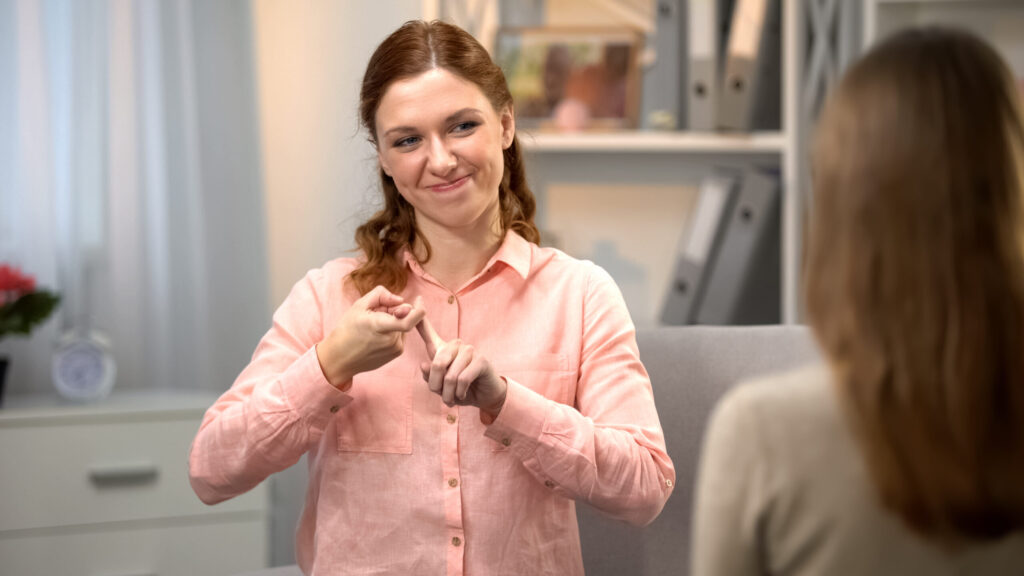
When we think about sign languages, it’s easy to assume they’re universal. After all, signing is a visual form of communication. It’s often assumed that one set of signs can be understood by Deaf people everywhere. However, this is a common misconception.
British Sign Language (BSL) and American Sign Language (ASL) are two distinct languages, each with its own unique grammar, vocabulary and cultural nuances.
Just as spoken languages differ across countries and regions, sign languages have evolved independently in various parts of the world. They reflect the history, culture and needs of the Deaf communities that use them. Their diversity is testament to their rich linguistic heritage.
The question of whether BSL users can understand ASL is complex and fascinating. It touches on issues of language acquisition, cross-cultural communication and the nature of visual languages.
In this blog, we’ll explore the similarities and differences between BSL and ASL, examining why mutual understanding isn’t automatic and what this means for Deaf people navigating international communication.
Is there a universal sign language?
While there are a handful of internationally recognised signs (International Sign, or IS), there isn’t a single version of sign language that every country uses and understands. Many people assume sign language is universal but just as suggesting everyone in the world should speak English, this isn’t the case. Even if it were possible to create a unified sign language for everyone to use, it would be impossible to prevent regional variants from developing.
To understand why BSL and ASL are different, it helps to look at their origins. BSL has its roots in the British Deaf community and has evolved over centuries, developing its own structure and lexicon. ASL, on the other hand, was influenced by French Sign Language (LSF) and has developed separately in the United States and parts of Canada.
One of the most striking differences between BSL and ASL is their grammar. BSL uses a two-handed alphabet, while ASL uses a one-handed alphabet. This fundamental difference extends beyond fingerspelling. The syntax and sentence structure in BSL and ASL also vary significantly. For example, BSL tends to follow a topic-comment structure, where the topic is established first, followed by the comment or action.
ASL often uses a subject-verb-object order, which is more akin to written English. These differences can make it challenging for BSL users to follow ASL and vice versa.
The vocabulary in BSL and ASL is also quite distinct. Many signs in BSL and ASL look entirely different, even if they represent the same concept. For example, the sign for ‘family’ in BSL involves two hands forming a circle, while in ASL, each hand comes together and forms the letter ‘F’ in the ASL alphabet, before drawing a circle in the air.
These differences mean even basic conversations can be difficult to follow without prior knowledge of the other language. Language and culture are deeply intertwined, and this is just as true for sign languages. The cultural contexts in which BSL and ASL developed have influenced the languages themselves. For example, certain signs or expressions that are common in ASL may not exist in BSL, and vice versa, due to cultural differences. These nuances can add another layer of complexity for BSL users trying to understand ASL.
Is it possible to learn both BSL and ASL?
While BSL users may not be able to understand ASL intuitively (and vice versa), it’s certainly possible to learn both languages. In fact, many Deaf individuals who travel or interact with Deaf communities in other countries do pick up different sign languages.
Learning ASL as a BSL user (or the other way around) is similar to learning a new spoken language – it requires time, practice and exposure to native signers. For those interested in becoming more versatile, there are courses and resources available to help bridge the gap between these two popular sign languages.
How can Sign Solutions help?
We provide BSL interpreting and translation services, plus expert consultancy, to help ensure your organisation is as accessible as possible, to attract and serve Deaf customers and offer equal opportunities for Deaf job applicants.
All the skilled BSL interpreters we work with are DBS-checked and NRCPD-registered and can provide a high-quality service to Deaf people across the UK. We can also provide a range of accredited communications professionals for Deaf, Deafblind and hard of hearing users.
To find out more and for expert advice on which type of communication support will meet your needs, give us a call on 0843 178 0773, email bookings@signsolutions.uk.com or contact us via a BSL video interpreter.