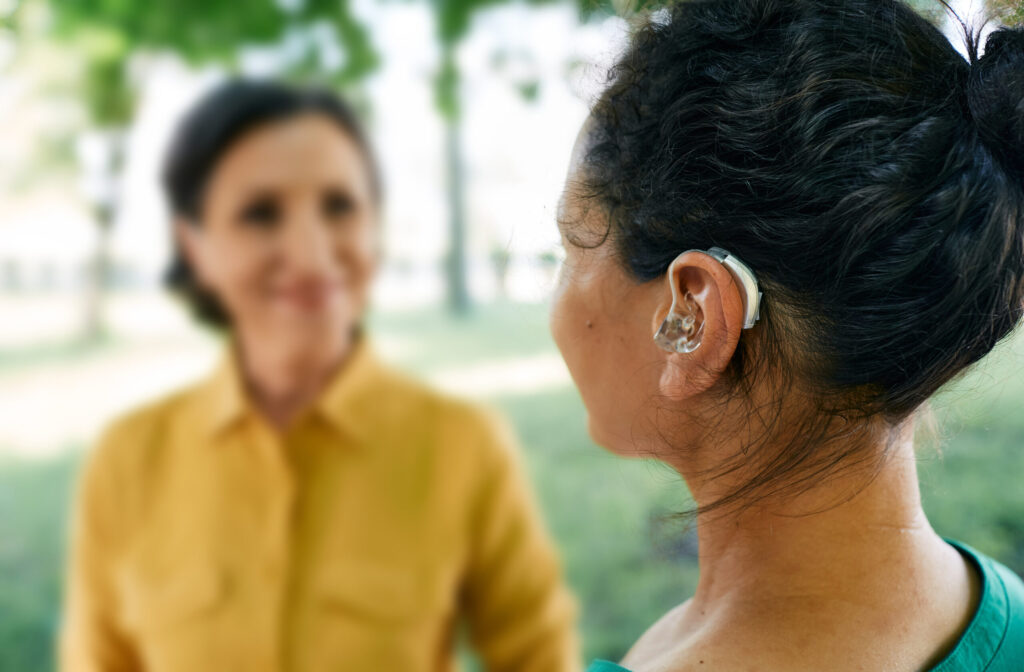
It can be tempting to group everyone with deafness or hearing loss under one label. However, in reality, hearing loss is a whole spectrum, not a single condition.
Different people may have different challenges and, therefore, require different adjustments to their lives. Being aware of the full spectrum of hearing loss means that you can more easily accommodate the needs of colleagues, friends and family who experience it. That’s what this blog is about.
Understanding the levels of hearing loss
The National Deaf Children’s Society categorises hearing loss into five categories according to severity. These are:
Mild deafness
A person experiencing mild deafness can usually hear conversation-level voices in a quiet room without the use of hearing devices such as hearing aids. However, they may find it difficult to hear whispering or distant voices and may struggle in noisy environments. They might miss a few words here and there, and over long periods of time, the concentration from straining to hear can become fatiguing.
Moderate deafness
Moderate deafness may present itself in a similar way to mild deafness from the outside. Those with moderate deafness can listen to normal conversations in a quiet room without a hearing device but might struggle to hear distant or quiet sounds. They may also find it hard to follow group conversations and could rely on lip reading, visual cues or hearing aids in busy environments. This may not always be obvious to an observer.
Severe deafness
While people with severe hearing loss may be able to detect loud sounds, they usually can’t conduct an everyday conversation without the use of assistive devices like hearing aids. They will often rely primarily on lip reading or sign language. This can be difficult to sustain for long periods of time for some people with severe deafness. It can also be isolating for those who find it challenging to keep up with conversations.
Profound deafness
Those with profound deafness hear very little at all. At most, they will detect very loud sounds.
Though hearing devices may make some impact, these people often rely entirely on BSL or other visual methods of communication.
Total deafness
There are a small number of people in the UK with complete hearing loss. They hear no sound at all.
Even a hearing device will not help their hearing, though they can feel vibration.
Causes of hearing loss
Hearing loss can result from a wide variety of causes. Many of these develop over time or later in life, so it’s essential to recognise that anyone could experience hearing loss during their lifetime.
Age-related hearing loss develops as you get older and is one of the most common causes. Similarly, repeated exposure to noisy working environments or using headphones at high volume can also cause hearing loss.
Illness and infections such as meningitis can lead to hearing loss, as well as exposure to certain drugs.
In some cases, hearing loss is genetic or congenital, meaning it has been a problem since birth and may have been inherited from parents or acquired during development in the womb.
Everyday challenges faced due to hearing loss
People with all levels of hearing loss face challenges in their day-to-day lives.
In the workplace, this might include difficulty hearing instructions or key information. Attending meetings or communicating via phone can be difficult. Offices can be noisy places, and background noise might make it challenging to conduct conversations.
There may also be safety concerns for those who can’t hear alarms or announcements. Visual alarms can alleviate some of the risk here.
Social situations in loud settings with large group conversations can feel daunting to people with hearing loss. This can sometimes create stress and mental fatigue, and can lead to feelings of isolation if they’re unable to join in.
Solutions and support
Many people with hearing loss benefit from a range of assistive technologies.
Hearing aids can help those with mild to severe hearing loss, improving clarity and reducing listening effort. Those with severe or profound hearing loss might use a cochlear implant, although these devices require a level of training and adjustment for effective use.
There is a range of technological solutions that can aid individuals with varying degrees of hearing loss, including speech-to-text apps, visual alerts and captions for live meetings and video.
The best thing that you can do for anyone with hearing loss is to build awareness of the issues they may face and be ready to accommodate them. They may have their own preferences and ideas about which communication methods work best for them, but there are simple actions that are universally helpful.
Face the person when you speak to them, speak clearly and reduce background noise. Ensure that lip reading is possible, with your face visible and well-lit. Written follow-ups can also be helpful, particularly in the workplace.
How can Sign Solutions help?
Hearing loss doesn’t apply in the same way to every person. It impacts different people in different ways.
However, general awareness and empathy can go a long way in helping people with hearing loss to feel supported and included without losing their independence.
At Sign Solutions, we offer a range of services, particularly in the workplace, to help support employers and employees to work with people with hearing loss. We can also provide Deaf awareness training and communications support to help you bring your colleagues together and build teams that thrive, whether your staff are hearing or not. Get in touch today to find out how we can support you in creating a more inclusive workplace.