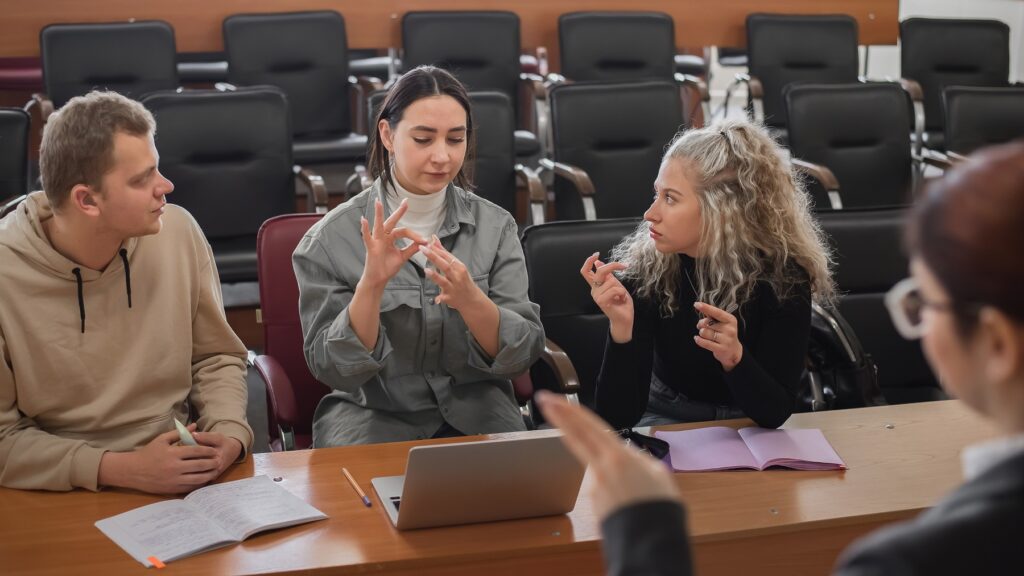
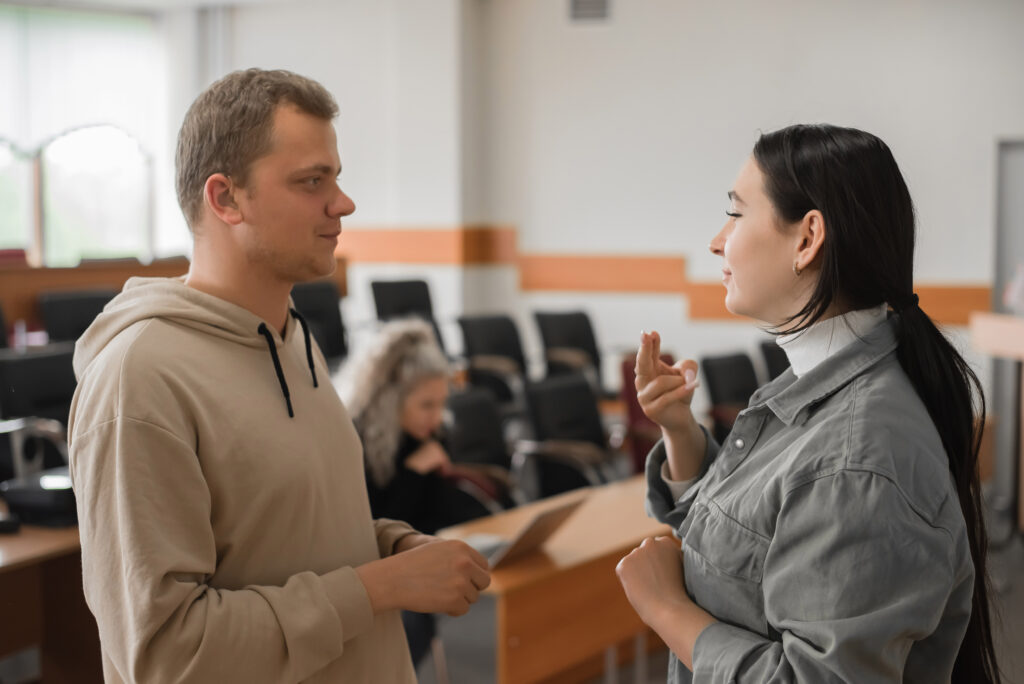
When you think of people who struggle with reading and writing, you might think of conditions like dyslexia. But, many Deaf people, particularly
BSL users, find it difficult to process written text because it’s technically a whole different language to British Sign Language. You wouldn’t expect a child from a different country to be fluent in their second language right away, and the same goes for a Deaf person.
Members of the Deaf community, particularly those who have been Deaf from birth, don’t have access to spoken English and because they can’t hear. This makes learning the basics like phonetics almost impossible.
Hearing children are taught to read or write using phonetics where word sounds are used to prompt recognition of letters and words which help to embed vocabulary and linguistic patterns. For a Deaf person this is a monumental task to achieve if you cannot hear to acquire the building blocks. Signed languages also have a different grammatical and sentence order making them very different with spoken and written languages and can prove difficult for
sign language users to translate effectively.
BSL Interpreter vs subtitles
The difference between
BSL interpretation and subtitles or closed captions may seem obvious on the face of it. Content that uses BSL accessibility will usually have a video overlay of a sign language interpreter at the bottom corner of the screen, watching the content and relaying it, in BSL, to the audience.
A video with subtitles, meanwhile, will feature a text version of the dialogue, which appears on-screen in sync with the speech, voiceover or narration. Closed captioning takes subtitles a step further by providing a visual description to supplement the dialogue with relevant soundtrack elements, such as background noises, phones ringing, dogs barking, music or other audio cues.
So, while BSL interpreting and subtitles/closed captioning serve different functions, they can both be utilised to help make video content more accessible to a Deaf audience.
However, both options deliver information differently.
Subtitles and closed captions are usually literal. They offer a verbatim transcript of any dialogue and, in the case of closed captioning, a description of any other relevant audio content.
Sign language, meanwhile, is more like translation. It’s structured differently, uses its own vocabulary and syntax, and conveys the information contained within the content in a more interpretive fashion. A BSL interpreter will use movement, body language, animation, and facial expression to convey the content’s emotion and tone, which subtitles cannot do.
They can also create a more human connection with the audience, which is more difficult through subtitles.
Although many Deaf people do rely on subtitles or lip reading when consuming media, as soon as a person covers their mouth, or the subtitles cease to work, this alienates the Deaf community. Similarly, if a Deaf person struggles with written text, as many do, subtitles and closed captioning just aren’t enough. Sign language offers a more inclusive way of communication for Deaf people and allows them to not only understand what’s being said, but an interpreter will also show any shifts in tone, additional sound effects or music which allows for a better experience overall. For younger Deaf audiences, they may simply not have adequate English skills to consume subtitles or captions.
Which is better, sign language or subtitles?
When it comes to deciding whether to use
sign language or subtitles to make your video content more accessible, your audience should be your primary consideration.
It’s easy to assume that the audience for videos using BSL interpreting and those using subtitles or closed captions is the same, but that’s not always true.
While the two audiences may be similar, there are some key differences which you should bear in mind which option you go for.
First, it’s important to remember that not every Deaf person uses BSL. Unless your video is explicitly targeted at BSL users, it may also be necessary to include any other accessibility options.
That said, videos using sign language interpretation can be useful for BSL users who may not be Deaf or hard of hearing. Students learning BSL and family members, friends or carers who use BSL to support a Deaf person may also benefit.
In terms of making video content more accessible to Deaf viewers, subtitles or closed captioning should also be utilised.
A wider range of audiences use subtitles for many different reasons – from translating dialogue into another language to enabling it to be viewed in a noisy environment.
However, because subtitles and closed captions feature verbatim speech, descriptive text and speaker identification, they are essential to help a Deaf audience engage with the content.
Subtitles have the added advantage of bringing YouTube or social media videos to life for viewers watching them with no sound.
The key takeaway is that BSL interpreting and some form of subtitling or closed captioning both play an essential role in making all content and information accessible when communicating with Deaf people.
While subtitling content in addition to BSL interpretation may seem like overkill, it will help make your videos more accessible to all, rather than only those who use BSL.
How to make your business more accessible for Deaf people
Business should always strive for better inclusivity both internally and externally. This includes making your internal staff meetings more accessible, as well as
training staff on Deaf Awareness, especially if your business is customer facing.
Around one in five adults in the UK is Deaf or has some level of hearing loss, so the chances are you’ll have hard of hearing employees and customers come through your door.
They all face different communication challenges, including difficulty with written text. So, by ensuring your staff are trained in Deaf Awareness with a basic level of BSL will make your business more accessible, which in turn will only increase your customer base and success.
Sign Solutions provides a full range of communication support services to help you make your business more accessible, including Deaf Awareness Training, video interpreting and BSL in-vision translation services, plus expert consultancy to help you share your content in a way that’s inclusive and effective. For more information on how we can help, give us a call on 0121 447 9620 or email
bookings@signsolutions.com.