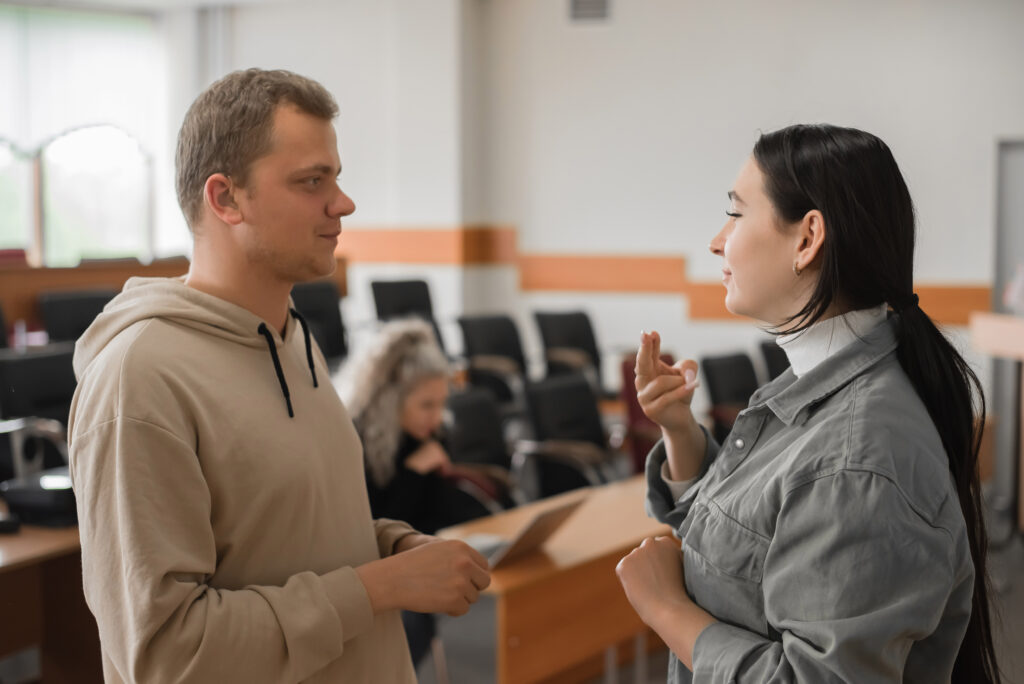
British Sign Language (BSL) is a visual language that uses hand shapes (signs), body language, facial expressions and lip patterns to communicate, instead of speech. All these elements play a key role in conveying information, tone, emphasis and meaning. That’s why BSL interpreters can be seen moving their mouths when signing. Facial expressions, lip patterns and other non-signed communication is referred to as non-manual communication.
BSL interpreters provide the essential service of facilitating communication between Deaf sign language users and hearing people. It’s a specialist profession that takes, on average, around seven years of training to master the language and interpretation techniques required to become a qualified BSL interpreter.
Interpreting involves several tasks that are completed consecutively. They listen to spoken English, process this mentally into appropriate signed language, then sign the message. If the Deaf signer responds, the interpreter must watch them carefully to understand their message, process this mentally into English then vocalise the message in spoken English. It’s a complex task that happens very quickly and expertly.
A BSL interpreter also ensures any cultural, contextual or linguistic differences – such as accents, dialects and metaphors – are communicated in a way that ensures all parties are included in the interaction. BSL interpreters are fluent in two or more languages and work in real time to simultaneously interpret signed and spoken information by each party.
BSL interpreters are essential in providing equal access for Deaf sign language users in their daily lives, workplaces and other public services.
What do BSL lip patterns mean?
Some people may think that lip patterns and shapes made by sign language users are mouthing the spoken words, but that’s not always the case. Sign language is a completely different language to spoken English and mouth movements used in line with sign language help emphasise particular words or prevent any misunderstanding, as some signs can have multiple meanings.
For example, niece and nephew, or number and date, have the same signs, which is where lip patterns or additional expression is needed to indicate the difference. Facial expressions and other body movements also help to convey meaning in BSL, much like hearing people do with spoken language. For instance, facial expressions can turn the sign for ‘excited’ to mean ‘very excited’.
What impact does this have in the workplace?
Many Deaf people still experience issues with audism – the belief that the ability to hear is superior to those with hearing loss – especially in the workplace. In order to break down the barriers to communication, businesses must become more aware, inclusive and accessible to Deaf people.
If your business uses a BSL Interpreter, it’s crucial that any Deaf and hard of hearing employees can see the interpreter without any obstructions. The visual nature of signed language means that users rely on being able to see the interpreter clearly at all times.
Creating the right environment for your physical meetings is vital. The room you use should be well lit and free from distracting background noise. Good lighting will help your Deaf colleagues see and interact with other attendees, as well as absorb signed information from the BSL interpreter.
Seating arrangements can also help break down a lot of communication barriers. Consider using horse-shoe style seating to enable Deaf participants to see attendees, speakers and interpreters for group discussions. Alternatively, you may want to reserve seating near the front so that the Deaf person has an unobstructed view of proceedings.
Where can I find a BSL interpreter?
If you need to make your workplace or event more accessible to a Deaf audience but aren’t quite sure where to start, Sign Solutions can help. Sign Solutions provides BSL interpreting and translation services in-person or online, plus expert consultancy, to help ensure your workplace or event is as accessible as possible.
All the experienced BSL interpreters we work with are DBS-checked, NRCPD-registered and provide high-quality services to Deaf people across the UK.
To find out more, and for expert advice on which type of communication support will meet your needs, give us a call on 0121 447 9620, email bookings@signsolutions.uk.com or contact us via a BSL video interpreter.