As technology has evolved, video calls have become crucial in connecting people worldwide.
For the Deaf community, advances like video relay service (VRS) and video remote interpreting (VRI) have opened new avenues for communication.
If you’ve ever wondered about the nuances and distinct features of VRI and VRS, and the benefits they bring to Deaf audiences, you’re in the right place.
In this blog, we aim to shed light on these two pivotal communication methods, discussing how they uniquely cater to the needs of Deaf individuals. Whether you’re part of the Deaf community, an interpreter or simply interested in understanding these services better, this will provide you with a clear, informative and engaging overview.
So, let’s dive in and explore VRI and VRS, and understand how they facilitate better communication for Deaf people.
Understanding the basics: VRI and VRS
Video remote interpreting and video relay service are two key communication methods that have revolutionised the way the Deaf community interacts in a predominantly hearing world. These remarkable technologies empower Deaf individuals in their daily communication.
While they may seem similar at first glance, they serve distinct purposes and operate under different mechanisms.
Understanding the intricacies of each method and how they work, their benefits and the contexts in which they’re most effectively used will help you and your organisation make the most of them.
Video Relay Service
VRS enables individuals who are Deaf, hard of hearing or speech-impaired to communicate over video telephones and similar technologies with hearing individuals in real-time, via a sign language interpreter. The interpreter appears on a video screen, translating spoken language into sign language so the Deaf person can understand what’s being said and vice versa.
Video Remote Interpreting
VRI, on the other hand, is a technology-driven service that provides real-time sign language interpreting through video conferencing. It’s typically used in office, healthcare or educational environments. VRI connects Deaf individuals with interpreters via a video link, allowing for immediate and on-demand access to sign language interpreting services.
The key difference between VRI and VRS lies in their application. VRI is used for face-to-face interactions through a remote interpreter, while VRS is for telephone conversations involving a Deaf person. Both play a crucial role in ensuring accessible communication for the Deaf community, each tailored to specific contexts.
VRS calls are often initiated spontaneously by Deaf individuals, who can make a call whenever they need assistance.
On the flip side, VRI calls are usually scheduled in advance. This scheduling component is especially beneficial in scenarios where a Deaf person knows they will need an interpreter. For example, at a medical appointment or a business meeting.
By scheduling VRI in advance, Deaf individuals can ensure that interpreting services are available when needed. This contributes to a more organised and planned approach to communication.

There are a few more nuances that differentiate VRI from VRS, which are worth highlighting.
In VRI, interpreters often have a more passive role, focusing primarily on facilitating communication between the Deaf and hearing individuals present in the same location. In contrast, VRS interpreters take a more active role, essentially becoming the voice and ears of the Deaf user, relaying information back and forth during the phone call.
With VRI, since the interpreter is remotely connected to a specific location (like a doctor’s office or a board room), there’s a higher level of control over privacy. In VRS, since calls can cover a wide range of personal or sensitive topics, the interpreters adhere to strict confidentiality standards, but the very nature of phone calls introduces varied and unpredictable environments.
The technology used might also differ. VRI often requires a stable setup with a good camera and screen for clear visibility, especially in professional or formal settings. VRS, being more personal and spontaneous, can be accessed through various devices like smartphones, tablets, or videophones, prioritising ease of use and accessibility.
Understanding these additional differences helps in appreciating how VRI and VRS can be tailored to meet specific needs within the Deaf community, each contributing uniquely to overcoming communication barriers in different scenarios.
Importance of tailoring communication for inclusivity
It’s important to recognise the unique needs and preferences of Deaf and hearing individuals. VRS and VRI aim to create an inclusive space where communication flows seamlessly between these two groups.
For a Deaf person initiating a VRS call, the spontaneity is empowering. It allows them to connect with hearing friends, family or colleagues in real-time without the need for extensive planning. VRS puts the control in the hands of the Deaf individual, providing a direct and immediate channel of communication.
For hearing individuals, both VRS and VRI offer a bridge to effective communication with Deaf counterparts. The visual element of sign language, whether in real-time spontaneous conversations or scheduled interactions, enhances understanding and fosters a more inclusive communication environment.
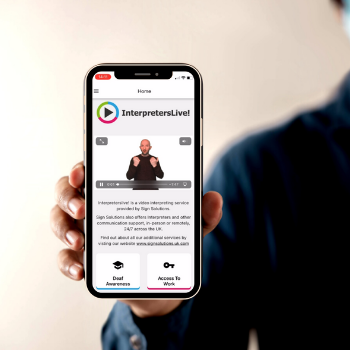
InterpretersLive!
Many businesses are inadvertently turning potential Deaf customers and employees away by failing to provide them with basic access to their organisation.
By having a video relay service like our InterpretersLive! link on your ‘contact us’ website page, you can enable Deaf people to make calls directly to your main phone numbers. You can also conduct a regular telephone call through a qualified British Sign Language video interpreter, only paying per minute for the call.
And our InterpretersLive! VRI service enables you to use any tablet, phone or computer with a camera and sound, to have a BSL interpreted conversation with a Deaf visitor to your premises.
InterpretersLive! is a one-of-a-kind innovation in video interpreting for Deaf and hearing people, offering seamless communication for your business, between employees and valued customers. It provides access on-demand and pre-booked, qualified NRCPD British Sign Language interpreters, and other communication professionals, 24 hours a day, 365 a year.
Find out more at www.interpreterslive.co.uk.