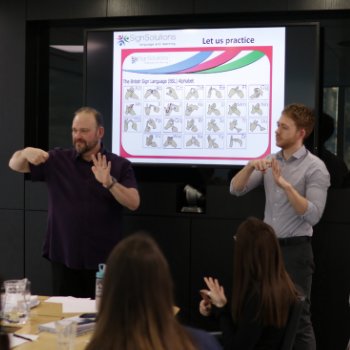
For many Deaf people, English – whether written or spoken – is their second or even third language. While some Deaf people are fully bilingual in British Sign Language (BSL) and English, many struggle to understand more complex language conventions and grammar or words that are less commonly used.
It means that members of the Deaf community may struggle to access services and information available to the wider community. This is where the need and demand for BSL Interpreters increases.
Why should you learn BSL?
BSL is the most common sign language used in the UK. It is a visual language that uses handshapes and facial expressions to communicate and convey meaning. It is a full-blown language with its own grammar and syntax. Learning BSL can help improve communication skills, not just for Deaf people but for hearing people too.
BSL offers people who are Deaf or hard of hearing a way to communicate with others that does not rely on spoken English. It is also beneficial for people who want to learn another language.
Learning sign language can also help to improve cognitive skills. Studies have shown that children who learn sign language perform better in cognitive tests than children who do not learn sign language. This is likely due to the fact that learning sign language requires the use of both the left and right hemispheres of the brain, which helps to improve overall brain function.
Learning BSL, even if it’s just basic signs to begin with, will help broaden your communication with individuals and increase inclusivity and accessibility for the Deaf community.
The Equality Act places a responsibility on public services and organisations to make their services accessible to Deaf and Hard of Hearing people.
By learning BSL within your organisation, you will instantly create a more accessible environment for any customers and current or future employees who are Deaf or hard of hearing.
Unfortunately, a common perception is that being Deaf is seen as something negative or lacking, whereas nothing could be further from the truth. Learning BSL and educating yourself and others will allow this misconception to be challenged and replaced with more accurate representation.
Benefits of becoming a British Sign Language interpreter
Becoming fluent in sign language can boost your career in several ways.
Professionals from different sectors have used their sign language skills to enhance services delivered to Deaf people. This has included police officers, solicitors, mental health nurses, and counsellors, to name a few.
One of the biggest benefits of learning BSL is that it can improve your communication skills. BSL allows you to communicate with people who are Deaf or hard of hearing in a visual way. This can be really helpful if you want to connect with someone who doesn’t speak the same language as you do. Learning BSL can also help improve your memory skills.
There are many other benefits to learning sign language, with a view to becoming a BSL interpreter.
First and foremost, BSL is the most common sign language in the UK, and it is estimated that there are around 150,000 deaf BSL users in the UK.
Being fluent in BSL is an extremely valuable skill, and many organisations and businesses hire BSL interpreters to help them improve their communications and interactions with a Deaf audience.
BSL interpreters play an essential role in the business world.
Businesses can enjoy several benefits by providing communication access for Deaf employees and customers.
Employers are supported by the government’s Access to Work grant, which provides part or full payment for BSL interpreters to support communication between deaf and hearing members of staff.
BSL interpreters can help to create a more diverse and inclusive workplace. This can lead to increased creativity and productivity and a better understanding of different cultures and lived experiences. Deaf employees also feel more valued and appreciated when they have access to communication in their first language.
BSL interpreters also help to improve customer service. Deaf customers can feel confident that they can communicate with businesses, leading to better customer satisfaction rates. In addition, companies can benefit from increased sales and marketing opportunities and improved public relations.
Where can I find a BSL Interpreter?
We provide BSL interpreting and translation services in-person or online, plus expert consultancy, to help ensure your organisation is as accessible as possible. All the skilled BSL interpreters we work with are DBS-checked, and NRCPD registered and provide a high-quality service to Deaf people across the UK.
We can also provide a range of accredited communication professionals for Deaf, Deafblind and hard of hearing users across all sectors and specialisms.
To find out more and for expert advice on which type of communication support will meet your needs, give us a call on 0843 178 0773, email bookings@signsolutions.uk.com or contact us via a BSL video interpreter.