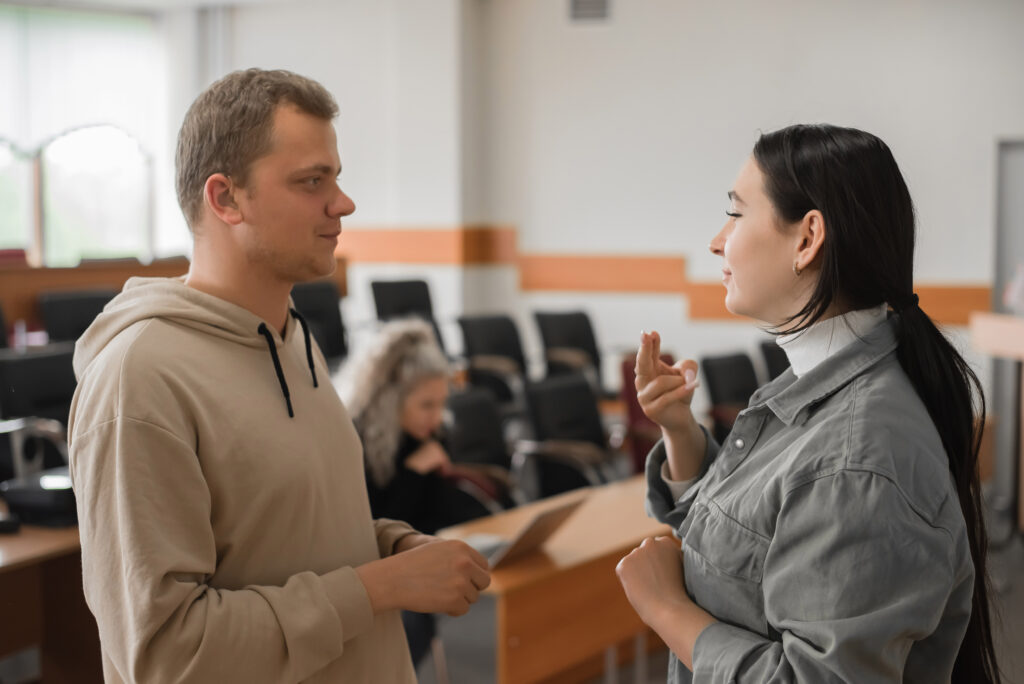
When members of the Deaf community give birth to a hearing child, this opens several questions about
how communication will work between them. A different dynamic is created compared to a family of all Deaf or all hearing people, as two languages are then required for more effective communication. New challenges arise as the child gets older, when it comes to childcare, discipline and many more.
Challenges Deaf parents and hearing children face
When it comes to the relationship between Deaf parents and a hearing child or children, this can create significant challenges for all involved.
Teaching/Learning BSL
Teaching a child
British Sign Language is the first step in breaking down the barriers of communication. Using BSL with a child from as young an age as possible will make it easier for them to learn to communicate with their parents. Not only that, it also gives the child foundational language skills, so they can build on this to become truly bi-lingual using BSL and English to communicate effectively.
Childcare
Finding the right childcare for children is a challenge in itself, without the added barrier of finding a provider who will be able to communicate with both the Deaf parent and the hearing child. The nursery or school will also need to be aware of how children of Deaf parents may behave differently to other children. For example, the child may be less aware of the noise they make and how that impacts people around them, due to living with parents who are Deaf or hard of hearing and less responsive to noise.
Discipline
As children get older, discipline is always a challenge, regardless of other factors in communication. The challenge for a Deaf parent is when a hearing child may start to take advantage of their Deafness. It’s important to be able to set boundaries with all children and to ensure respect is understood from both sides.
Accessibility
When it comes to the nursery nativity or school talent show, children of Deaf adults may feel slight anxiety that their parents won’t be able to understand or take part. To avoid this, schools should provide sign language interpreters for performances to ensure inclusivity for the parents, as well as
teaching inclusivity to all the children.
Healthcare
It is often the case that a hearing child of a Deaf parent may be expected or pressured to become an interpreter for their deaf parents appointments, hospital visits or running errands. Children should never be used as interpreters in any kind of formal capacity and legally NHS, public and private sector organisations have a duty of care to provide qualified and professional BSL interpreters. Placing these responsibilities on a child to interpret medical information to a parent is irresponsible and risks impacting all parties both physically and emotionally. Policies like the
Accessible Information Standard
and the
Equalities Act Guidance which explains expectations of service providers to provide access to Deaf users.
Are children of Deaf parents at a disadvantage?
In short – absolutely not.
If anything, having access to both spoken communication and sign language is a blessing and should be celebrated. For most children who are hearing, their primary language will be sign language if their parents are Deaf.
Spending time with close friends or family who are hearing will aid in the child’s ability to use spoken words as well. Most children of Deaf adults will eventually become fluent in both English and sign language, making them bilingual, which research shows bring many benefits mentally and intellectually.
A child of Deaf parents also has access to their own sub-community within the Deaf community called CODA (Children of Deaf Adults). CODA provides workshops, camps and a general safe space to meet other CODAs for both children and adults.
How can Sign Solutions help?
If you’re a school or
healthcare provider looking for advice and support to make your business, services and information more accessible to Deaf or hard of hearing families, Sign Solutions can help.
We provide
BSL interpreting and translation services in-person or online, plus expert consultancy, to help ensure your organisation is as accessible as possible.
All the skilled BSL interpreters we work with are DBS-checked and NRCPD-registered and provide a high-quality service to Deaf people across the UK. We can also provide professional translation services by providing BSL videos for sharing your information online in a BSL accessible format.
We can also provide a range of accredited communication professionals for Deaf, Deafblind and Hard of Hearing users in various sectors.
To find out more, and for expert advice on which type of communication support will meet your needs, give us a call on 0843 178 0773, email
bookings@signsolutions.uk.com or contact us via a
BSL video interpreter.