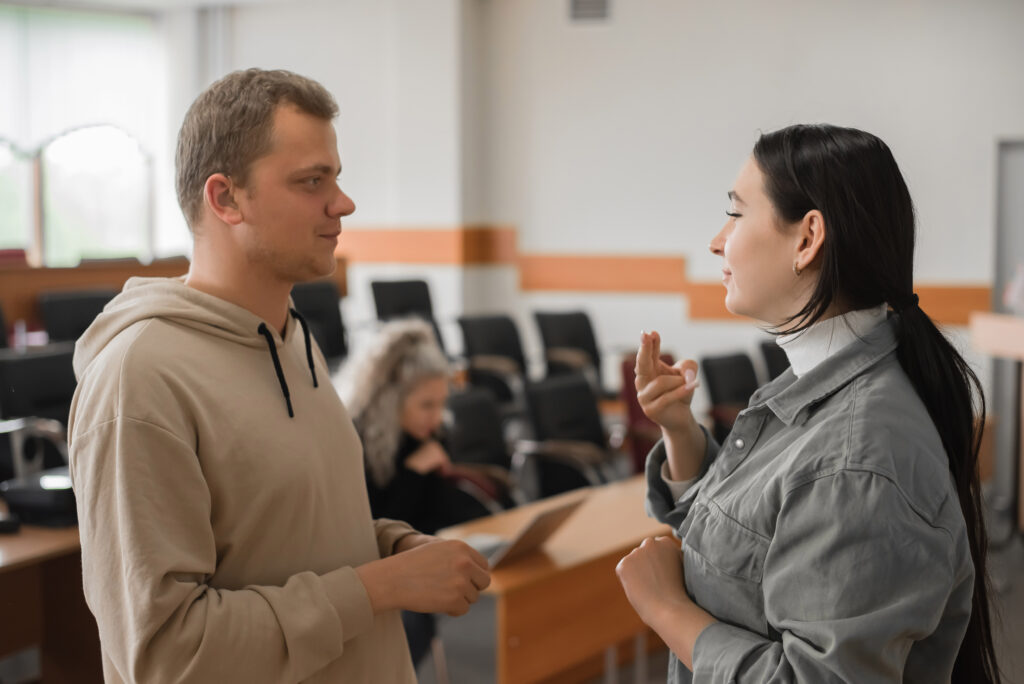
As with spoken language across the globe, sign language is also used across the world. With over 300 sign languages in use around the world, they all vary from nation to nation.
You wouldn’t expect a native English speaker to understand someone talking in French. However, users of sign languages can often understand portions of a foreign signed language, due to some similar features found in most signed languages.
Using ‘iconic’ signs that look like the thing they are expressing, gives sign language users the ability to understand people who use a different sign language. For example, the sign to ask for a drink looks very similar across most sign languages. It’s the action of putting a receptacle to the mouth and acting like you are drinking. This feature is not found in spoken languages because they don’t have a visual component like sign language does.
Deaf people in the UK predominantly use British Sign Language (BSL) to communicate but even within the UK, different regions have their own unique dialects and colloquialisms. This means that a Deaf person from the South of England, for example, may use different signs to someone from Scotland or the North of England.
Does sign language differ between countries?
Along with BSL, there are several sign languages used by English-speaking countries, including the US (ASL), Auslan and NZSL. Ireland also has its own sign language (ISL), which is derived from French Sign Language but shares similarities with BSL.
One of the most widely used sign languages around the world is Chinese Sign Language (CSL or ZGS), which has up to 20 million users.
Brazilian Sign Language has around three million users worldwide, while Indo-Pakistani Sign Language has about 1.8 million users across South Asia.
Is there a universal sign language?
In short, no. While there are a handful of internationally recognised signs (International Sign, or IS), there isn’t a single version of sign language that every country uses and understands.
Many people assume that sign language is universal but just as suggesting everyone in the world should speak English, this isn’t the case. Even if it were possible to create a unified sign language for everyone to use, it would be impossible to prevent regional variants from developing.
Like spoken language, different groups and cultures develop their own ways of communicating unique to their region and lifestyle.
There are many different sign languages in the world, but they are all based on a similar system of manual communication. In general, sign languages are not mutually intelligible. However, because of iconic signs, gestures and shared agreed signs, Deaf people across the world can learn to communicate with each other fairly quickly.
Sign language isn’t just about hand and body gestures either. Facial expressions and lip patterns are also crucial in conveying information, tone, emphasis and meaning. For example, an ASL user might use a ‘shrug’ to mean ‘I don’t know’, but an Irish Sign Language user would use the same gesture for ‘I agree.’
What’s the difference between BSL and ASL?
Although the United States and the United Kingdom both mainly speak English, there are still clear differences between American Sign Language (ASL) and British Sign Language (BSL).
A key difference between ASL and BSL is their alphabet. While ASL uses a one-handed manual alphabet, BSL uses a two-handed manual alphabet. There are some similarities in the two sign languages, but a BSL user would still struggle to fully understand ASL without some prior knowledge of the language and vice versa.
How can Sign Solutions help?
Many businesses and organisations simply don’t know where to start when it comes to communicating with a Deaf audience and might wrongly assume that providing BSL interpretation is enough to meet the needs of all Deaf and Hard of Hearing users.
This couldn’t be further from the truth. There are many actions a business can take, to make themselves more accessible to a Deaf audience and that’s where Sign Solutions can help.
We provide BSL interpreting and translation services, plus expert consultancy, to help ensure your organisation is as accessible as possible, to attract and serve Deaf customers and offer equal opportunities for Deaf job applicants.
We work with skilled BSL interpreters who are DBS-checked, NRCPD-registered and provide high-quality services to Deaf people across the UK.
We can also provide a range of accredited communications professionals for Deaf, Deafblind and Hard of Hearing users.
To find out more, and for expert advice on which type of communication support will meet your needs, give us a call on 0121 447 9620, email bookings@signsolutions.uk.com or contact us via a BSL video interpreter.